6‑handed dentistry
The workflow that can cut treatment times in half
Every dentist has, at some point, worked entirely unassisted. It’s possible, in the same way it’s possible to ride a bike uphill in the wrong gear. You can do it, but it’s slow and punishing.
Add a nurse and the operation becomes smoother. Four-handed dentistry is the standard for a reason: it lifts the dentist out of the weeds and lets them focus more on the things that only a dentist can do.
But there’s a limit to what four hands can achieve. Most dentists hit that ceiling without ever recognising it. They assume the friction they feel — the small delays, the constant shifting of attention, the fatigue that accumulates through the day — is simply “the job.”
That’s not true. The workflow is the culprit. Improving your dental practice workflow is the single most under-explored break through available to most dentists.
It’s stupid to dismiss something I haven’t tried
Years ago, someone mentioned 6-handed dentistry on a dental chat line. I brushed it off pretty much straight away.
I thought that I was already working optimally with one nurse. I knew my routines. I knew my instruments. I knew my materials. I believed I had everything sorted. What could a second nurse possibly add? Another salary to pay every week? Another body in the room? Another person to train? It felt like a pointless exercise, not something that would benefit me.
But the thought kept nagging.
I’ve never liked the idea of dying wondering, and so I decided: “It’s stupid to dismiss something I haven’t tried.” So I tried it. I brought in a second nurse and we gave 6-handed dentistry a go. What happened was one of the biggest surprises of my career.
My treatment times on many procedures didn’t just get shorter, they collapsed. Thirty to forty percent faster almost immediately, and with refinement, even more. My working day became smooth and effortless. My stress dropped and my end-of-day fatigue was greatly reduced.
There are no official statistics on how many dentists work 6-handed which tells you something. If it were common, it would appear in workforce reports but it doesn’t. Very few dentists are doing it, and yet the benefits of 6-handed dentistry are extraordinary. The absence of data is a clue. It shows just how far outside the mainstream 6-handed dentistry still is, and how easy it is to dismiss simply because it’s unfamiliar. I certainly did. And like most dentists, I had no idea what I was missing.
A huge benefit is the protection of your focus
When you’re working 4-handed, you have many small (and not so small) moments when you’re waiting for an instrument to be passed, or a material to be mixed, or something to be set up, or you’re looking away to pick up instrument, or you’re changing a bur, or you’re mentally juggling the next step while trying to stay on top of the one you’re doing. Each interruption is small, but they accumulate. They chip away at your concentration. They force your brain to keep switching tracks. This is the driver behind how to reduce dentist fatigue, not fewer patients, but fewer small interruptions.
I noticed it so clearly when I moved to 6-handed dentistry.
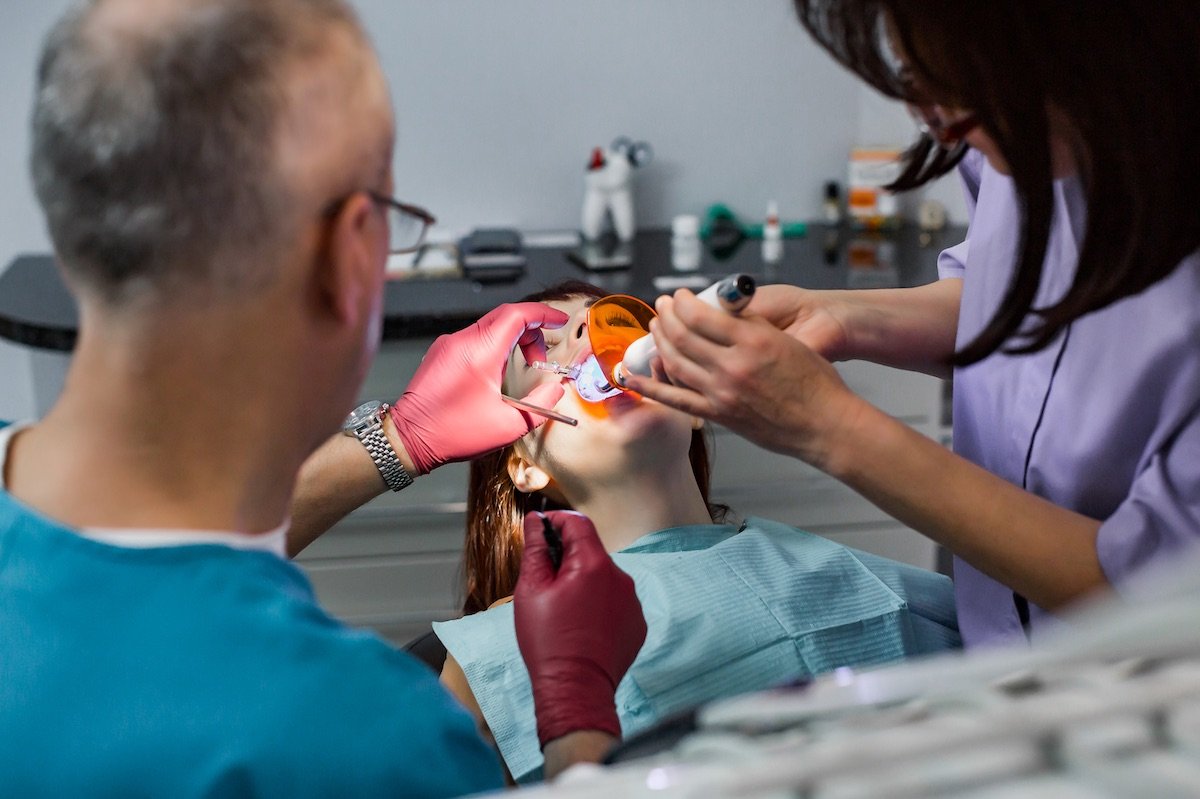
Suddenly, I never had to change my burs. All I had to do was put my hand out and the nurse would give me the handpiece with the correct bur already inserted. I never touched the curing light, the nurse handled that. I never had to hunt for instruments. The right one appeared in my hand exactly when I needed it, without me shifting my eyes or breaking rhythm for even a moment.
Most dentists think they’re tired because dentistry is demanding. But in reality, you’re not tired from the dentistry. You’re tired from the constant small disruptions. Remove them, and the experience changes.
With 6-handed dentistry, those disruptions disappear. You never wait. You never hunt. You never shift your eyes or your attention away from the tooth you’re working on. Everything arrives exactly where you need it, exactly when you need it, without you having to think about it. The entire surgery becomes choreographed around your focus. You stay in the zone, uninterrupted, for the entire procedure.
The result is mental clarity. The feeling of doing high-quality dentistry without any background noise. The sense that your day is unfolding with rhythm instead of resistance. You feel sharper, more present.
Why 6-handed dentistry pays for itself many times over
Now let’s talk about the economics of 6-handed dentistry. It functioned as if someone had added extra hours to my day by freeing me to focus totally on treating patients. Working 6-handed gave me the equivalent of an extra 2 to 3 hours of productive time working on patients every single day. 2 to 3 hours. Not once a week. Every day.
Now let’s apply your hourly rate to that. Say, for example, it’s $800 per hour. Some dentists produce more; some produce less but $800 is a reasonable ballpark figure. Two to three extra hours at $800 per hour is between $1,600 and $2,400 of additional revenue per day. Let’s take the average of $2,000 per day. Over a standard 5-day work week, that’s $10,000. Over a year, it’s close to half a million dollars extra revenue not by working harder, but by adding a staff member.
The cost of an additional nurse becomes irrelevant in comparison. Once you’ve paid the nurse’s wage, most of the additional revenue goes straight to profit because all your other costs are already covered — the only extra cost of going 6-handed is one extra wage and a little bit of materials. The return on investment isn’t subtle. It’s dramatic, immediate, and ongoing.
Here’s an irony: dentists often look for financial improvements in the wrong places. They try to increase production by adding more procedures, extending hours, or pushing harder. But those gains, if any, come at a cost. 6-handed dentistry gives you financial gains and makes your life easier, simultaneously.
The day they blitzed it
Here’s a surprising example that a dentist shared with me.
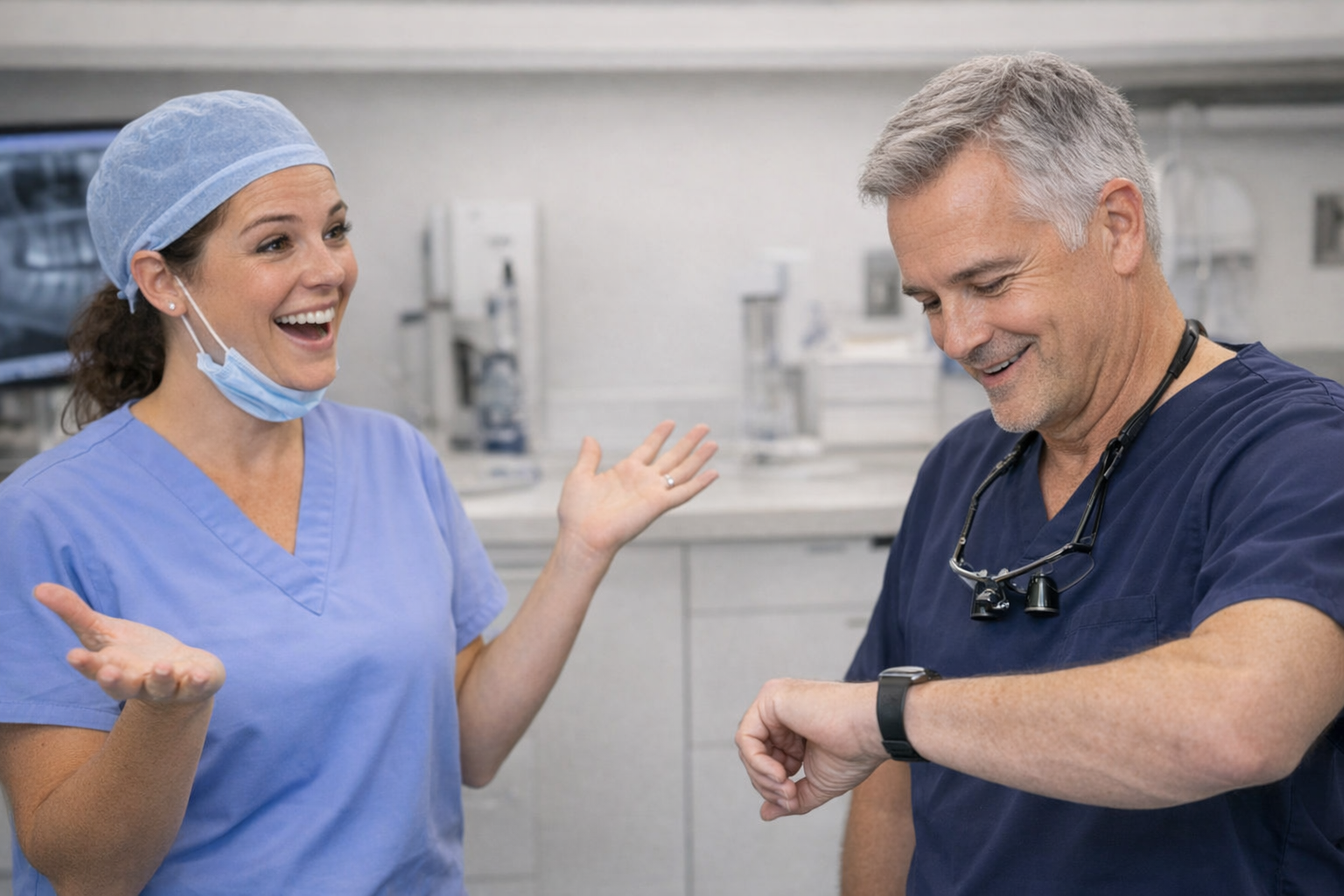
He had a standard day booked with one chair-side nurse when his Oral Health Therapist rang in sick. Rather than cancel the OHT’s patients, he decided to see them all using the OHT’s nurse alongside his own. Two nurses. 6-handed for the day.
He ran on time. He saw his full schedule and the OHT’s full schedule. To use his own words: “We blitzed it.”
The explanation is straightforward. With one nurse, a dentist typically spends around 50% of their time actually working with patients and 50% waiting for things to be ready. With two nurses, that flips. 90% or more working on patients, 10% or less waiting.
A different dentist shared his experiences with me: treatment times for some procedures dropped from twenty minutes to five.
For the first time in his career he found himself standing in the hallway with nothing to do, waiting for the next patient rather than the other way around. He started getting out of the office on time every night. He stopped taking work home at night and stopped coming in to the office on his days off.
Once you experience it, you won’t want to go back
If you’ve never tried 6-handed dentistry, it’s hard to imagine the difference, but once you’ve experienced it, you won’t want to go back.
Like riding uphill on an e-bike instead of a normal bike. Same journey, completely different experience. The work becomes easier because everything around you is aligned with the flow.
For me, the shift was transformative. It changed how I scheduled, how I delegated, how I trained my team, and how I thought about the value of my own time and attention. It made my days feel shorter, my procedures run smoother, and my stress levels lower. It reminded me of something every dentist needs to hear: your focus is your most valuable clinical asset. Protect it, and everything improves.
Would you like help implementing 6-handed dentistry in your practice?
Some teams pick up 6-handed dentistry quickly on their own. Others prefer a little guidance because the choreography is easier to learn when someone shows you how the pieces fit together.
If you want support, I’m happy to visit your practice and walk your team through the exact movements, positioning, anticipation, and flow that make 6-handed dentistry feel effortless. It’s a practical session that leaves everyone feeling more confident and more connected.
But whether you bring me in or explore it yourself, the message is simple: this way of working can change your day, your dentistry, and your energy in ways that are hard to imagine until you feel it.
If you’re curious about 6-handed dentistry, try it. Notice what happens to your focus, your speed, and your stress. It may be the single most impactful workflow upgrade you ever make.
If you’d like to go deeper, my Efficiency course covers the full system, including 6-handed dentistry, built entirely on real chairside experience.























Does 6-handed dentistry work or is it an expensive luxury?