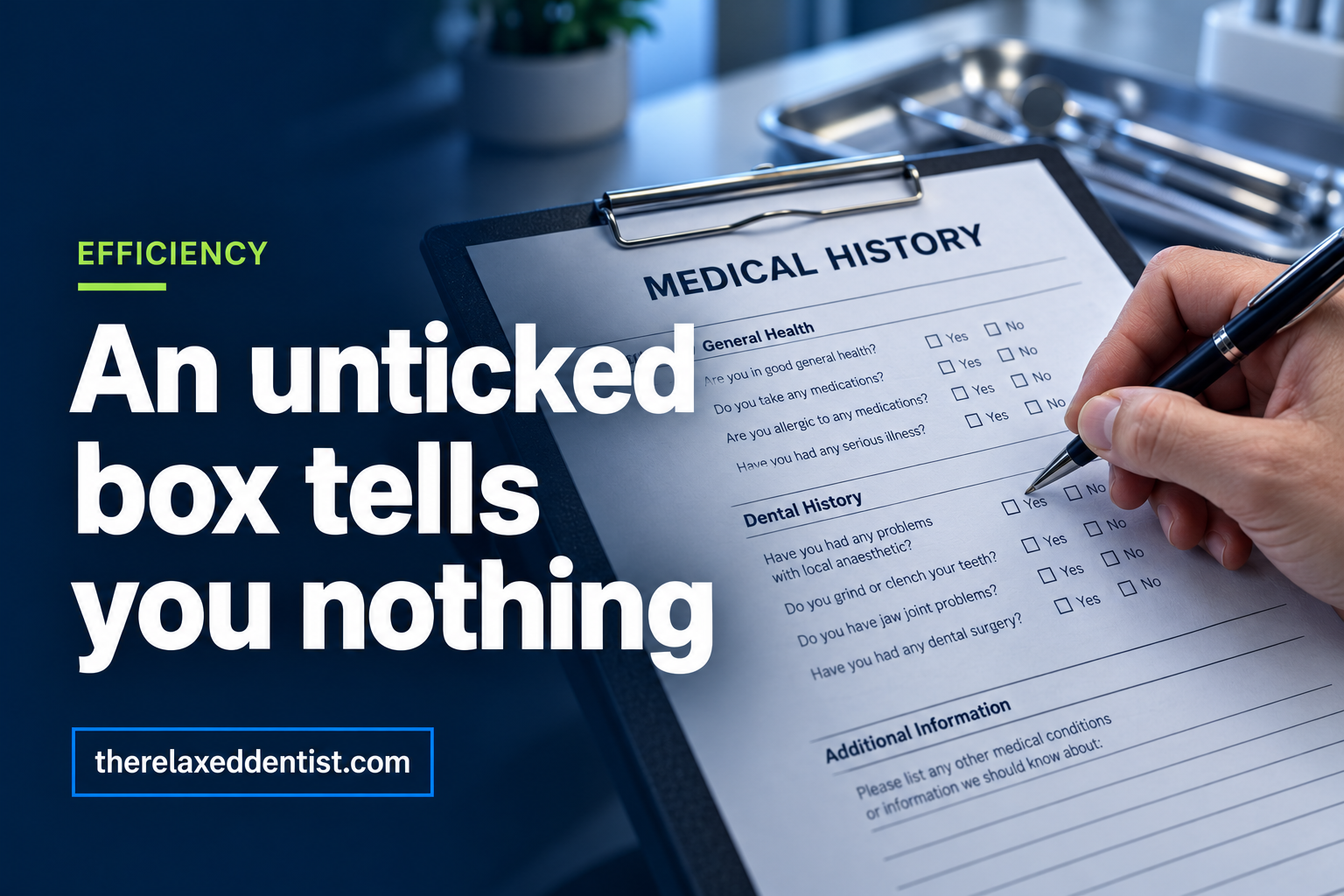
The majority of new patient forms that I see pose medical questions in this way:
Have you ever had rheumatic fever? ◻︎
Seems good but what does it mean if the patient does not tick the box? Unfortunately it can mean either one of two things:
The patient has never had rheumatic fever or,
The patient did not read and answer the question.
Therefore, a “non-tick” is ambiguous.
I’ve seen patients fill in the top of a new patient form, skim over the medical questions in 2 seconds and then sign the bottom of the form. This is clearly unsatisfactory.
So, how should medical questions be put?
Here’s my suggestion:
Have you ever had rheumatic fever? ◻︎Y ◻︎N
Putting questions in this way demands a response. If the patient does not tick one box or the other it immediately tells you that they did not read the question.
When you put questions on the new patient form like the example above you will discover that about 20% of patients hand back the form with neither “Y” nor “N” ticked.
Whenever that happened my staff would hand the form back to them and tell them that they needed to answer each question either “Y” or “N”.
Doing this removes ambiguity. It also, in my opinion, puts you on a better footing from a medico-legal point of view.
Fewer tools, fewer steps, fewer decisions. Minimalism in dentistry leads to better outcomes, lower costs, and a happier dentist.
Dental practices do three things: attract patients, gain their agreement on treatment, and deliver the care. Get all three right and your practice will thrive.
One of the cheapest, most useful pieces of kit I've ever used. It retracts the tongue and gives you a dry field without the fuss of rubber dam. Here's why the "curly suction" deserves a spot in every surgery.
I cut 12 hours from my working week and increased my net income. The change came from rethinking how my practice worked. Here’s how to make productive days easier.
Doing fewer procedures and doing them brilliantly leads to better outcomes and a more profitable practice. Here's the case for focus in dentistry.
It's less tiring to produce $8,000 per day than $1,500. This deep dive explains why and what separates practices that feel effortless from those that grind.
A streamlined approach to crown preparation that delivers predictable clinical results in 30 minutes. How to work faster without cutting corners.
The most efficient dentist I ever watched never kept anyone waiting. His approach taught me why small problems in setup, scheduling and workflow can leave the rest of us running behind all day.
Some patients cost far more than the appointments they miss or the fees they pay. They drain your energy, unsettle your team and take the pleasure out of dentistry. Here are patient types I’ve learned to be wary of, and why.
6‑handed dentistry boosts productivity, and lowers stress. Most dentists overlook this workflow but it can add hours of productivity to every week.