Why dentists run late
Dentists don’t run late because they’re slow. They run late because their systems and workflows create choke points.
Running late is like quicksand. Once you get drawn in you keep sinking deeper and deeper. One moment you’re prepping a molar, and before you blink, you’re thirty minutes behind, your DA is tight‑lipped, and your next patient is at reception asking: “How much longer?”.
I learned a lot about running on time from the most efficient dentist I’ve ever seen, Dr Omer Reed from Phoenix. Omer never kept anyone waiting yet he delivered enormous amounts of dentistry. He didn’t rush. He simply worked in a way that was efficient.
Once, I watched him prepare two premolars for gold onlays. I thought he was just getting started but he’d already finished. It was like watching a concert pianist whose hands move so rapidly you can’t see the technique, only the result. Omer taught me a simple truth: running on time shows respect for the patient, the team, the craft of dentistry and yourself.
Here a list of time sucks that push dentists behind schedule and what to do about them.
1. Poor setup
The appointment begins when the dentist walks into the surgery. If the instruments aren’t set, if the lab work isn’t on the tray, or if the nurse is off doing something else you’ve already lost time.
It’s like starting a concert before the band has set up. Would a singer step on stage if the band wasn’t ready? Of course not. They only come out when everything is ready to go. Efficient dentists do the same. When you walk in, it should be all systems go.
The way to know the surgery is not set properly is if your DA needs to leave the room or call out for missing items during the procedure. If that keeps happening you must tighten up your setup procedures.
2. Overly tight scheduling
Some dentists schedule based on best-ever scenarios rather than typical ones.
Let’s say that a Class II takes you 28 minutes to complete if everything runs perfectly. You should not scheduled it as a 30‑minute appointment. You should schedule to your average and also include a few minutes as a buffer.
If you schedule to your best-ever timing the result is predictable. The day will start on time and slowly drift off course. On-time dentists schedule based on actual averages, not hope.
3. Excessive chat
Warmth matters, but too much small talk ruins the balance.
Years ago I ran an experiment. For one month, I did zero chat other than saying hello at the start of the appointment. Everything else was about the dentistry. Guess what. The patients didn’t miss it. No one complained and my treatment acceptance rate was the same.
That experiment taught me something important: patients come to the dentist to get their teeth fixed, not for conversation. Efficient dentists keep chat brief. One of the best dentists I know at gaining rapport never chats for more than 20-30 seconds.
4. Leaving the surgery mid‑procedure
This is one of the biggest time sucks. Dentists leave the room to check hygiene, look at a lab case, or to start another patient. It sounds efficient: “Look at me, I’m multi-tasking.” In reality, it destroys momentum.
Every departure means de-gloving, re‑gloving, and rebuilding focus. It’s like stopping halfway through a marathon to browse the shops. You finish the race, but not on time. Patients notice too. They wonder why you keep disappearing. They feel abandoned.
My simple rule is, once I sit down I’m glued to the seat until the procedure is finished. That mindset forces you to commit, stay present, and design your workflow so everything you need is in the room.
5. Patients adding things
A patient says, “While I’m here, can you have a quick look at this tooth?” or “A tooth on the other side is sore. Can you fix it as well?” or “My teeth need a clean. Can you do it today?” Some dentists say yes out of kindness.
It’s impossible to create time out of thin air. A “quick look” rarely turns out to be quick. It normally requires x-rays or other diagnostic tests. It disrupts the flow of the appointment, steals time you don’t have and pushes your day behind schedule.
When patients try to add extra treatment on top of what they’ve booked for honesty is the best approach: “I’ve only got enough time to fix one problem today. You pick which one.”
6. Not delegating sufficiently
Some dentists behave as if they’re the only worker in the building. For example, they adjust the light, get their own instruments and burs, type the notes, write the referrals and fill in lab sheets.
The cost isn’t just time, it’s also focus. Every time you do a task that you should have delegated you drain mental energy. By the end of the day, you’re worn out. Efficient dentists only treat patients and delegate everything else to the staff.
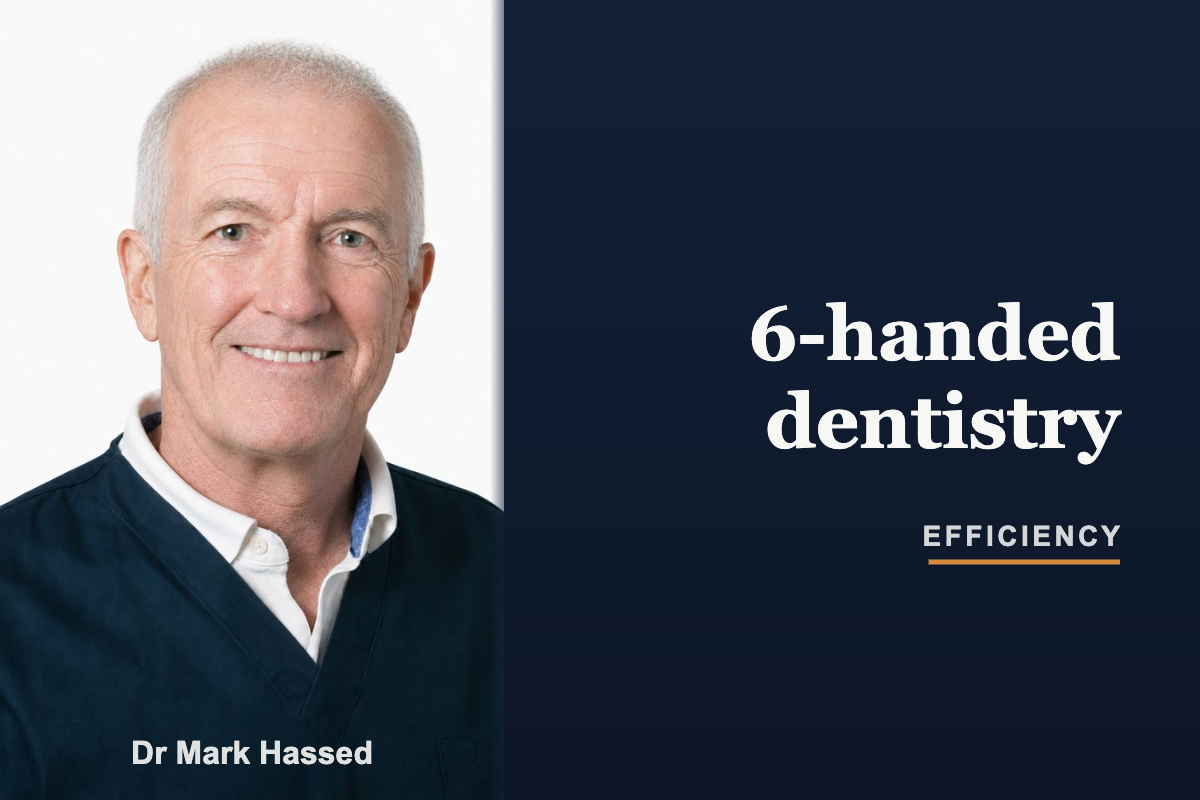
If you have two well-trained DAs (6-handed dentistry) they will anticipate the next step, the next instrument, the next movement allowing you to stay in the zone. The procedure becomes a smooth choreography instead of a scavenger hunt.
7. Too many materials
A large menu of materials slows things down. If you have five different bonding agents and six types of composite every decision takes longer. Choices create delay. There’s a great book on the topic called The Paradox of Choice by Barry Schwartz.
I’ve heard dentists say: “Let’s use OptiBond. No, on second thoughts G‑Bond. No, Clearfil SE.” Meanwhile the DA is wondering why everything needs to be so complicated. Decisions about bonding material should be baked into your routine. Doing that removes improvisation and guesswork.
Efficient dentists don’t have more materials. They have fewer and they use them consistently.
8. Spending time on data entry
One of the saddest sights in dentistry is a dentist typing notes during their lunch break. Lunch should be a reset. When you use your only long break doing admin work the afternoon feels heavy.
I try to avoid touching the computer altogether, not because I consider myself above it, but because I understand the cost. Every minute spent typing is a minute I’m not resting.
On-time dentists delegate documentation. The DA or AI enters the notes, and the dentist verifies at the end. Templates, shortcuts, and structured phrasing keep the process efficient. Your attention should be on dentistry, not data entry.
9. Redoing work
Redo work is a thief of time. A high spot, a rough margin, a contact that needs adjusting. Each of these steals minutes from your future schedule. Common is an open contact point that packs food. Now you’re re‑doing work you already did for free.
Post‑operative sensitivity is another big one. A tooth that zings every time the patient bites is a guaranteed time‑suck. Find a bonding protocol that eliminates sensitivity and warn patients that teeth may take time to settle.
Make sure to slow down at the right moments. Check margins, occlusion, and contacts with care. Floss every contact. Thirty seconds of precision can prevent thirty minutes of correction.
10. Not respecting the patient’s time
Most lateness isn’t intentional, but sometimes it is. I know dentists who deliberately keep patients waiting because it makes them feel in demand. They believe it reinforces their status and importance. In reality, it makes them difficult to respect.
Dentists need to realise that patients’ time is as important as their own. If the patient is a company executive their hourly rate may well be higher than yours.
Patients notice when you run late. Some don’t mind but many find it irritating. They become less cooperative and harder to work with. If you keep doing it, some will leave the practice which is a sad way to churn and burn patients.
11. Talking on the telephone
Nothing breaks the flow of an appointment like a phone call. A call from the lab, an order to your broker or a personal call you choose to answer. Each one breaks your concentration and robs you of minutes you never get back.
My rule was simple: “If the practice is on fire, come and tell me. If it’s not, I don’t want interruptions.”
The bonus for being interruption-free is that patients love having your undivided attention. They feel better cared for when you’re fully present with them.
12. Allowing patients to control the pace
Some patients slow the appointment. They ask lots of questions, tell irrelevant stories, or need extra reassurance. I once had a patient who removed his shoes so he could show me a problem with his feet.
Inefficient dentists let patients set the tempo. Efficient dentists guide the appointment. If a patient is disrupting my day with too much talking I say to them: “We need to get on with things or we won’t be able to finish your treatment.”
If they kept disrupting I would cut down the amount of treatment and let them know why.
13. Starting the day behind
Arriving late or just as the first patient is due is a self‑inflicted injury. It’s unnecessary and it sets off a chain reaction that affects the whole day. You begin the day in a defensive state. You have no margin for error. I always say, if you’re not early, you’re late.
Efficient dentists arrive 15 minutes before the first patient. They review the schedule, anticipate challenges and set the tone for the team. That 15 minutes lets you settle and focus.
A day that begins smoothly usually stays smooth. A day that begins in a rush rarely recovers.
14. Incomplete treatment plans
When there is no clear, written treatment plan the appointment becomes a guessing game. I’ve been in practices where the treatment plan is written in the patient chart as “NV CT” (“Next Visit Continue Treatment”). That is completely vague and hopeless.
In such practices, the nurse sets up for one procedure while the dentist is thinking of another and the patient believes they’re having something different again. Time is lost clarifying, explaining, resetting expectations, and reorganising.
Dentistry moves fastest when everyone in the room knows exactly what is happening. A clear written treatment plan that’s communicated to both the patient and the team eliminates confusion and gets the appointment moving from the moment you sit down.
15. Late‑arriving patients
Some dentists allow late patients to derail their day. A patient arrives fifteen minutes late, and instead of adjusting the plan, the dentist tries to deliver the full appointment in less time. This creates stress and a schedule that rarely recovers.
If a patient arrives late, the appointment should be shortened or rescheduled. It’s not punitive; it’s practical. I used it as a teaching moment for late patients and after missing out on expected treatment very few patients came late a second time. Of course this presupposes that you run on time. You can’t train patients to respect your time if you don’t respect theirs.
By shortening a late-arriving patient’s visit, it preserves the flow of the day, respects the patients who arrived on time, and keeps you in control. A schedule needs to be defended.
16. Emergencies
One of the fastest ways to lose control of your day is to let emergencies walk into the middle of it. You have the perfect day planned, everything is balanced then someone comes in off the street saying they have a toothache.
You want to help them but jamming them into an already full day pushes everything over the edge. Suddenly you’re stressed, the team is scrambling, and you’re thirty minutes behind with no way to recover.
The answer is simple: emergencies must wait. They cannot be allowed to disrupt patients who booked ahead and trusted you to run on time. Emergency patients get seen at the next available gap, or at the end of the session, or in a dedicated emergency slot but never at the expense of scheduled patients.
Final thoughts
When you’re behind schedule, your communication gets worse, your decision making deteriorates, your team becomes anxious and your patients feel the pressure. It becomes a loop.
When you’re on time, everything works better. Your team moves with ease, your patients appreciate the rhythm and dentistry is more fun. Being on time affects your enjoyment of practice and the quality of your work.
If you have a problem with running late, you should find the causes somewhere in this list. No dentist I’ve ever met has all the issues, but those who chronically run late usually have three, four, or five of them working against them at the same time. The first step to fixing the problem is honest reflection.
Efficiency isn’t a personality trait you either have or don’t. It’s a choice you can make starting tomorrow.





Dental practices do three things: attract patients, gain their agreement on treatment, and deliver the care. Get all three right and your practice will thrive.