5 Productivity Boosters Every Dentist Should Use to Work Faster and Stress Less

Dentistry is a rewarding profession — but it is also one of the most demanding. Add the weight of running a practice to the physical toll of chairside work, it’s no wonder that burnout has become common in the dental practice.
The question of how to increase productivity in a dental practice is one I've spent four decades thinking about — and the answer is almost never what dentists expect.
The assumption that higher productivity must come at the cost of personal wellbeing is a false one. In reality, the two goals are deeply aligned.
When you streamline your workflows and create systems that support both you and your team, you become more productive and less stressed. The following nine dental practice productivity tips offer a practical roadmap to achieving exactly that.
1. Master the Art of Appointment Block Scheduling
There came a point in my career when I realised I simply did not want to do molar endodontics late in the afternoon. When I was tired, a difficult upper molar root filling was an absolute nightmare. The straw that broke the camel’s back was a day when I had two molar root fillings scheduled one after the other at 4.00pm and 4.45pm.
That realisation shaped how I scheduled from that point forward.
All complex work — crown preparations, endodontics, anything that required deep focus — went in the morning. By lunchtime, I already had a substantial portion of the day's revenue in the bag. My afternoon could be filled with lighter work: check-ups, simple restorations, hygiene-adjacent appointments. The flow from challenging to easy during the day left me relaxed when I went home.
Block scheduling is really about matching your best energy to your most demanding work. Many dentists schedule based on the patient’s availability rather than what suits them: “Oh, you want to come at 11.00pm to get you root filling done? No problem.”
By setting boundaries on what you will do when and the day starts manageable and ends manageable.
2. Delegate Assertively and Build a High-Trust Team
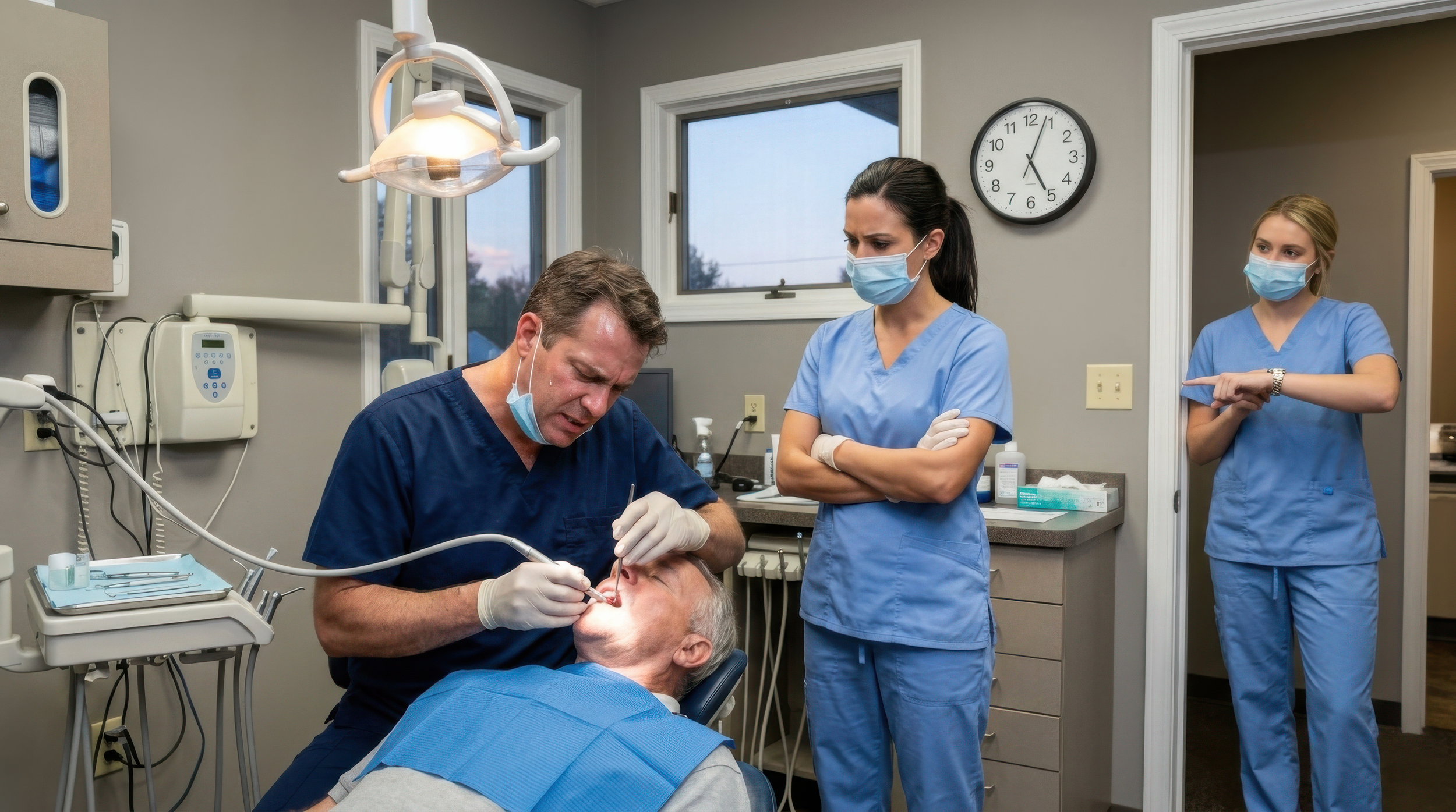
One of the most common stress intensifiers for dentists is the delusional belief that they must personally oversee or perform every task in the practice.
A good friend of mine suffered from this problem. He described the feeling to me as: "It is like my staff are walking about carrying single sheets of paper while I am staggering around with a weighty pile of books on my back."
Feeling you need to do (or check) everything leads to micromanagement, bottlenecks, and a team that never fully develops its capabilities. Effective delegation is not about offloading tasks — it's about placing the right responsibilities with the right people.
The rule I had in my practice was that I refused to do any task that I was able to delegate. That left me to spend 100% of my time diagnosing and treating patients.
Train your dental and front desk staff to operate to their full scope. When team members can handle patient education, instrument preparation, charting updates, and follow-up calls without check-ins, you free up your mental bandwidth for clinical excellence.
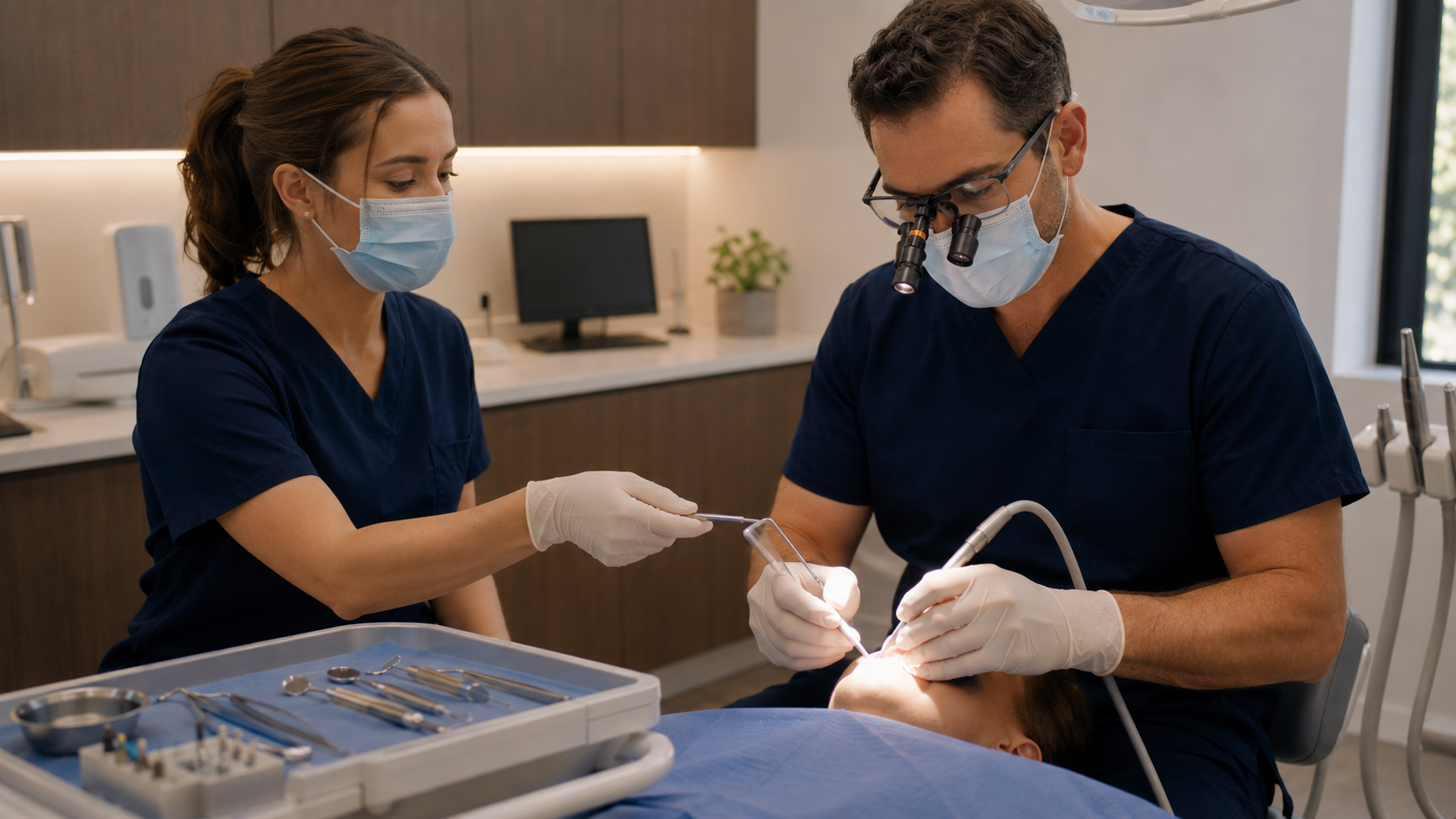
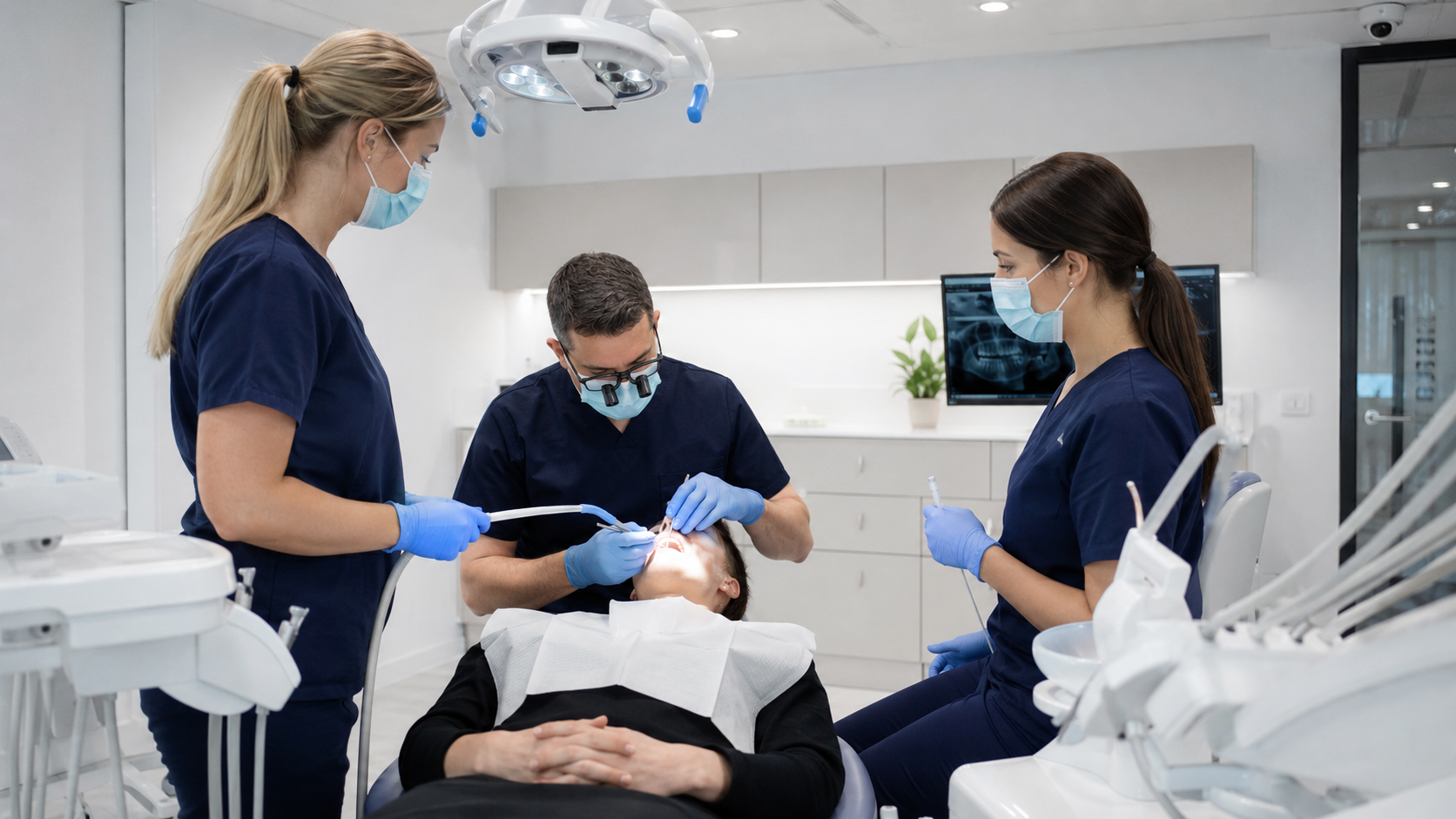
The most dramatic expression of this principle is 6-handed dentistry — a workflow that cuts treatment times by 30–40% and virtually eliminates end-of-day fatigue by removing every task from the dentist's hands that doesn't require a dentist. Trust your team, and you will find that both productivity and morale rise together.
3. Standardise and Systemise Clinical Procedures
It never ceases to amaze me how dentists just make stuff up on the fly. Let's say they're doing a Class II composite — a procedure they would have done thousands of times. Yet they'll sit there and dither: "Let's have the Optibond. No, on second thought we'll have the G Bond."
It shouldn't be that difficult. You don't need five brands of composite and four different bonding systems.
For every standard procedure, work out the flow and then stick to it 100% of the time. Step 1, step 2, step 3, step 4, done. It will be a tremendous weight off your mind and the nurses will love the fact that you are predictable. It lets them set up properly and know every stage of the procedure. Sometimes I would do a quadrant of crowns — my nurse and I would work for an hour or more without needing to say a word. We could do that because everything was standardised.
Standardisation also keeps you fresh for when something genuinely difficult arises — placing a tricky implant, navigating an unexpected complication — because you haven't spent your cognitive reserves on decisions that should have been made once, years ago.
4. Protect Your Time with Robust Cancellation Policies
I visited a practice a while ago to consult with a dentist. Her 10.00am patient didn't arrive and was rescheduled by the front desk. I asked to see the patient's record. It turned out that this patient had failed 14 appointments over the past three years — roughly 50% of the time. Given what practice overheads are, the dentist would have been better off financially giving that patient $500 and telling them to go elsewhere.
The saying goes: leopards can't change their spots. I concur. Unreliable people will almost always be unreliable. You don't want them in your practice stealing your time and your money. The overheads don't stop just because the patient didn't turn up.
Patients in my practice got one failed appointment before they were asked for a deposit on future bookings. To my great regret I relented once. A patient had failed two appointments and wanted to book a third. She gave me a compelling sob story and swore she would turn up next time. I agreed — no deposit. Guess what. She failed a third time.
5. Use Efficiency to Give You More Free Time
For the vast majority of my practising life I worked four eight-hour days a week — 8.00am to 5.00pm, an hour for lunch, and six weeks of holiday a year. In spite of that, my practice was consistently among the most productive in my community.
How?
Efficiency. Not working harder or longer, but using every hour at the chairside so well that I never needed more of them. The goal was never productivity for its own sake — it was the lifestyle that productivity made possible. More time at home. More holidays. Finishing on time, every day, without the creeping guilt that you've left something undone. Running on time so you have a full hour to unwind at lunchtime to recharge your batteries.
Most dentists think the path to a better income runs through longer hours. In my experience it runs through better systems. A dentist with excellent systems working four days a week will outperform a dentist without them working five — and go home with more energy besides.
If I had to distil it to a single principle it would be delegation. The moment I stopped doing anything that someone else could do, everything changed. More time with patients. More time at home. Less of that end-of-day hollowness that comes from spending your best hours on tasks that have nothing to do with dentistry.
Efficiency isn't about squeezing more in. It's about creating room — for the work you love, and for the life outside it.
If you'd like to go deeper, my Efficiency course covers the complete system — and The Productivity Paradox is a useful companion piece that explains why the highest-producing practices are also the least stressful.





Doing fewer procedures and doing them brilliantly leads to better outcomes, less stress, and a more profitable practice. Here's the case for focus in dentistry.