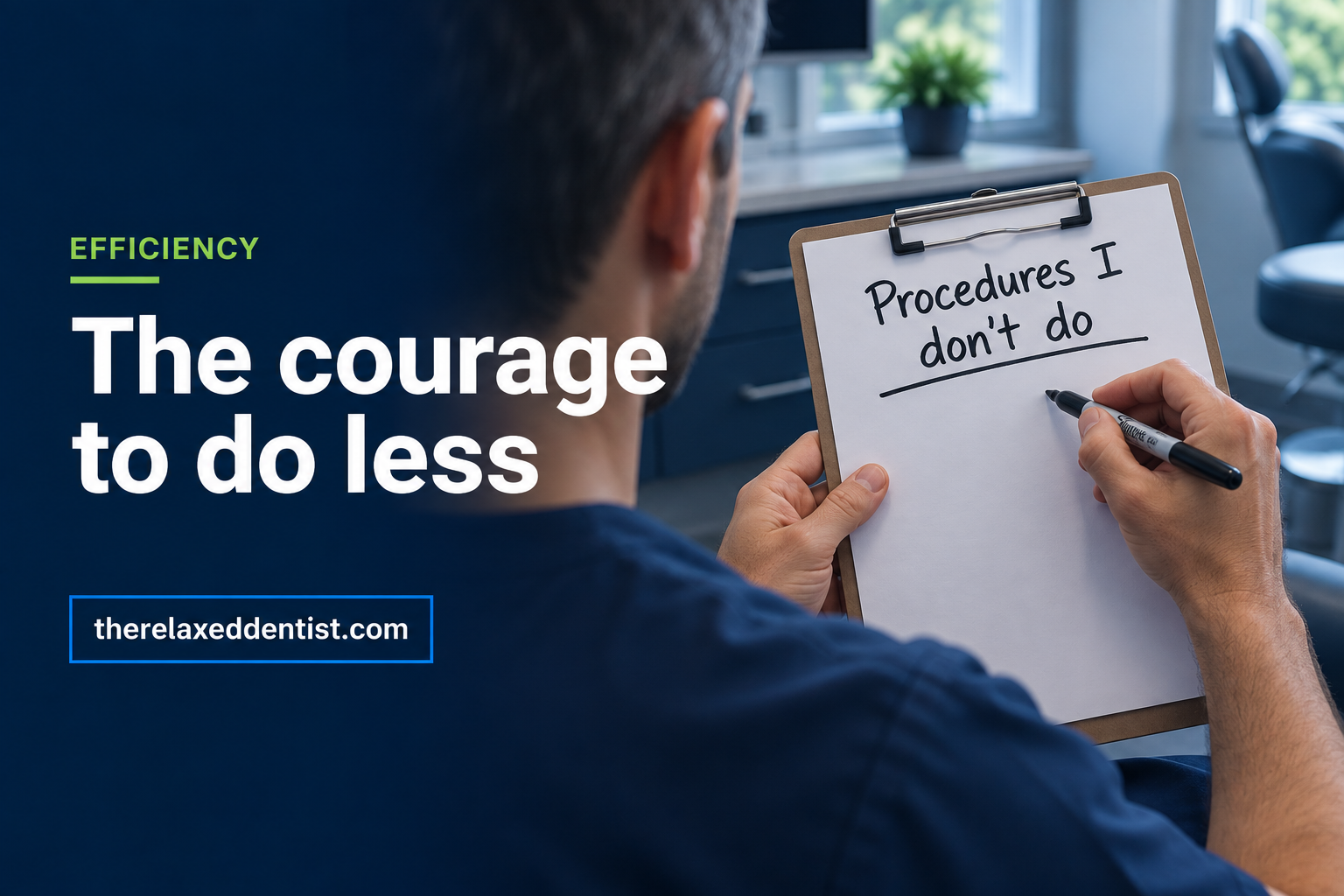
The courage to do less
I was at a wine tasting recently. Small producer, passionate winemaker. The kind of event where the person who grows the grapes also pours the wine for you.
He made eleven different wines. I tasted my way through them and found nine were mediocre and two were excellent.
The two outstanding wines were ones that you remember. But the other nine? Why were they there? More to the point, why wasn’t he concentrating on the wines he was brilliant at, and making more of them?
I asked him. He said that customers expect a full portfolio. I’ve heard versions of that answer before. Just not usually from a winemaker. I hear it from dentists.
There is a powerful and largely unexamined assumption running through the dental profession: a good dentist does everything.
Extractions, endodontics, implants, orthodontics, sleep appliances, Invisalign, composite bonding and full-mouth reconstructions. To refer a patient out is to admit a limitation. To focus on a narrower range of procedures is to leave money on the table, or worse, to signal to your patients that you’re not up to the job.
I want to challenge that assumption, because it’s costing dentists quality of life, clinical outcomes and profitability. Building a more successful dental practice starts not with doing more, but with doing less.
The winemaker with eleven wines isn’t offering variety. He’s diluting his excellence. The same logic applies to dentistry. Every procedure you perform that sits outside your zone of competence and enthusiasm is a procedure that gets less than your best.
Let me share a personal story.
In my last practice, I made a decision that surprised some colleagues: I wouldn’t see children. Dentists told me I was mad. I would miss out on the family market, they said. I’d be leaving an important revenue stream on the table.
What actually happened was the opposite. By designing children out of the equation entirely, I created physical, psychological and strategic space to become something specific. I became the adult restorative dentist.
The practice was designed around that positioning. There were no children’s books in the waiting room, no toys on the floor and no cartoon characters on the walls. Instead, there was an espresso machine, considered decor, and a calm atmosphere that spoke directly to adults who were serious about their dental health.
The patients who found me weren’t there by accident. One of them said something I’ve never forgotten: “I’ve been seeing Dr X for years but now it’s time to get my teeth fixed properly. That’s why I came here.”
I created the conditions for that to happen.
Just after I opened the practice a man came in his forties came in. He didn’t realise I was standing in a side hallway. I could watch him without him seeing me. He stood in reception and looked around. Then he did something interesting. He nodded slowly to himself as if to say: “I like this place.” He subsequently had his entire mouth restored.
He hadn’t even met me. He made his decision based on what the practice communicated about who I was and who I served. That only works when you’ve made clear choices about your positioning. Clear choices require the courage to leave things out.
I’m not suggesting that dentists should only perform a handful of procedures and nothing else. I’m talking about something more nuanced: the difference between procedures you do well and enjoy versus procedures you do reluctantly or poorly. Most dentists can sort their procedural repertoire into those two buckets without much difficulty.
The procedures in the first bucket (the ones you do well and enjoy) are the ones where time flies. These are the procedures where your outcomes are excellent and the work energises rather than drains you.
The procedures in the second bucket are a different story. Tricky molar root fillings that leave you tense for the rest of the afternoon. The surgical extraction that you wish you’d never started. The lower denture that the patient hates. These cases cost you more than the fee you collect. They cost you energy, confidence and peace of mind.
And here’s the thing: when you’re spending time on procedures in the second bucket, you’re unavailable, physically and mentally, for procedures in the first bucket. You’re not just doing things poorly. You’re crowding out things you do brilliantly.
Take implants, as another example. I chose not to place them. Not because I lacked the training, but because I had made an assessment of the economics and the efficiency. The inventory, the equipment, the setup, the surgical time, the clean-up, the management of complications when you’re only placing a handful of implants a week don’t make sense. Instead, I referred placement to an oral surgeon who did several of them every day and was brilliant at it.
This is what it looks like when dentists refer more patients strategically. It’s not a loss of income, but a gain in quality, efficiency and clinical satisfaction. That is a referral network working as it should.
There’s a non-dental story that I think about when this topic comes up. A chef built a restaurant that became very popular. The food was great and bookings were difficult to get. He was a success. Then he decided to scale. New restaurants followed. Different concepts, different suburbs. The logic seemed sound. He had a recognised name and a following. Why not leverage that?
What followed was a painful unravelling. His core skill was being a chef. The expansion required payroll systems, HR, compliance knowledge, rostering and meticulous financial controls. He had no passion or talent in any of this areas. The business collapsed. The original restaurant, the brilliant one, the one that had started everything, went down in the wreckage.
He failed because he assumed that the skills which built his success were the same skills required to scale it. They weren’t. This distinction matters enormously for dentists considering the same leap.
I know a dentist who built a successful practice on the back of their own clinical excellence. Encouraged by that success, they expanded to two locations, five associate dentists, twenty staff. From the outside it looked impressive. From the inside it was a relentless grind of administrative complexity, staff management, compliance obligations and operational headaches.
Then they took a 3-month break from practice for medical reasons. In their absence, the practice’s profitability dropped to zero. Not reduced. Zero.
Every cent of profit the business generated had been produced by their own clinical hours. Strip those out and the two locations, the five associates, and the twenty staff produced nothing. They had not built a business. They had built an overhead structure that their personal effort was subsidising, dressed up to look like growth.
Running multiple dental practices is not dentistry at scale. It’s a completely different job, requiring different skills. Most dentists who try it discover this too late.
I’m not arguing every dentist should become a specialist. What I’m arguing for is a specialist mindset: an honest assessment of where your excellence lies and a willingness to concentrate your energy there while building strong referral relationships for everything else. This is a dental practice efficiency strategy that cost nothing to implement and pays dividends immediately.
The ancient observation that nature abhors a vacuum turns out to be as true in dental practice as it is in physics. By never seeing children in my practice, I didn’t end up with empty appointment slots. The spaces filled with the kind of patients I wanted to serve, drawn by a practice that spoke directly to them.
When I didn’t place implants, I didn’t lose income. I freed up clinical time for the restorative work I did well and my referral relationship meant my patients were better served than if I’d attempted everything myself. The vacuum fills. It always does. It fills with better work, because you’ve made room for it.
The dentists who are most financially successful, most clinically satisfied and least stressed aren’t the ones doing everything. They’re the ones who’ve made decisions about what they do brilliantly and built their practice around those procedures. Their patients aren’t disadvantaged by this. They’re better served.
The winemaker I mentioned at the start should make two wines. The chef should have stayed in one kitchen.
If you’re honest about which procedures light you up and which ones drain you, you already know which parts of your day you should be sticking to and which parts you should be handing off to someone else.
Excellence isn’t about doing more. It’s about doing the right things at the highest possible standard. That’s not a limitation. That’s a practice worth building.
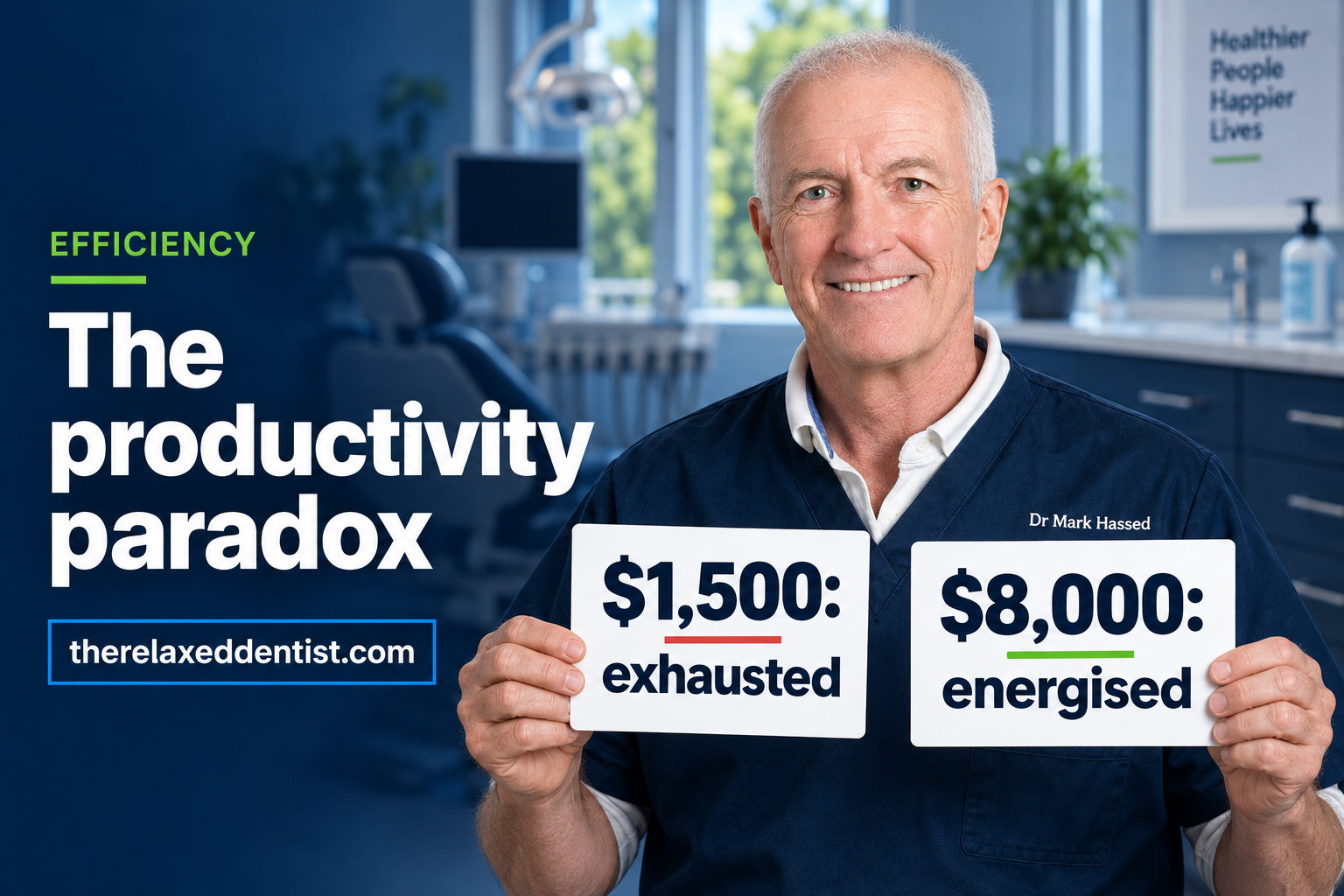
If the question of how to build a more profitable dental practice while working with less stress interests you, my Efficiency course covers the full system built entirely on real chairside experience. You might also find The Productivity Paradox a useful companion to this piece.


Fewer tools, fewer steps, fewer decisions. Minimalism in dentistry leads to better outcomes, lower costs, and a happier dentist.