The cost of clutter
Every practice tells a story the moment you walk through the door. Some rooms feel light, intentional, almost effortless.
But many reveal a different truth — ten feet of bench space buried under instruments, materials, and the residue of a thousand “just in case” decisions.
It looks harmless, but it isn’t. Clutter doesn’t just fill a room. It slows a mind.
Over the years I’ve watched how this plays out in real clinical moments. I’ve seen dentists lay out fifteen hand instruments for a simple Class II restoration, as if the procedure might suddenly transform into something exotic.
I’ve watched clinicians rummage through drawers of burs, searching for the one they “always use,” only to settle for something close enough because they can’t find it.
I’ve seen crown‑prep kits with nine burs when the dentist only ever touches three.
I’ve seen restorative cupboards stocked with six different composite systems, each with a full shade range, because at some point someone believed variety equalled quality.
None of this improves dentistry. It only slows it down.
Minimalism, in the clinical sense, isn’t about austerity. It’s about clarity. It’s about stripping away everything that doesn’t directly contribute to the quality of the work.
When you reduce your instruments and materials to the essentials, something interesting happens: your hands move more confidently, your decisions become cleaner, and your appointments start to flow.
My own bur kit, for example, has served me for years with just eight burs — and if you don’t do inlays or minimal intervention dentistry, you can comfortably work with six.
Not because six is a magic number, but because the discipline of choosing forces you to understand what you actually need. And once you know that, everything becomes easier.
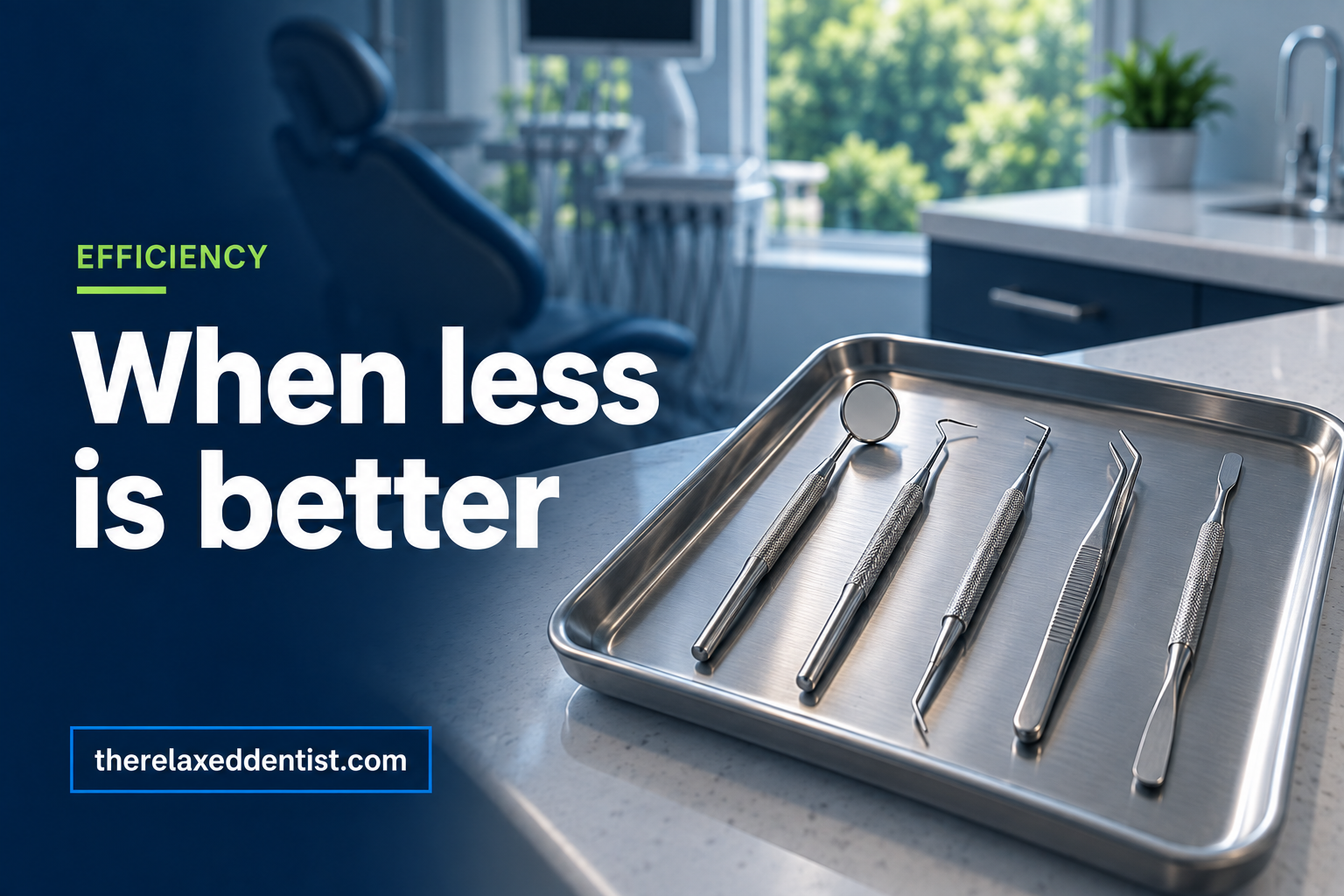
The same applies to hand instruments. Do you really need three sizes of excavators? Do you need multiple variations of the same instrument because you once used one in a course ten years ago?
Do you need a dozen composite shades when you consistently reach for the same two? When you embrace minimalism, you stop hunting. You stop hesitating.
You stop wasting micro‑decisions on things that don’t matter. And those micro‑decisions add up. They’re the difference between a day that feels smooth and a day that feels like you’re constantly fighting the room.
Clutter is not a neutral presence. It’s a drag coefficient. It slows your hands, your thinking, your rhythm, and your ability to stay fully present with the patient in front of you.
The moment you experience the ease of a truly streamlined operatory — the moment you feel how light the work becomes when the room stops competing for your attention — you realise something simple and liberating.
You were never short on time. You were just surrounded by too much noise.






6‑handed dentistry boosts productivity, and lowers stress. Most dentists overlook this workflow but it can add hours of productivity to every week.