Fear of rejection
“The majority of dentistry is not completed because it was never presented.” — Dr. L. D. Pankey
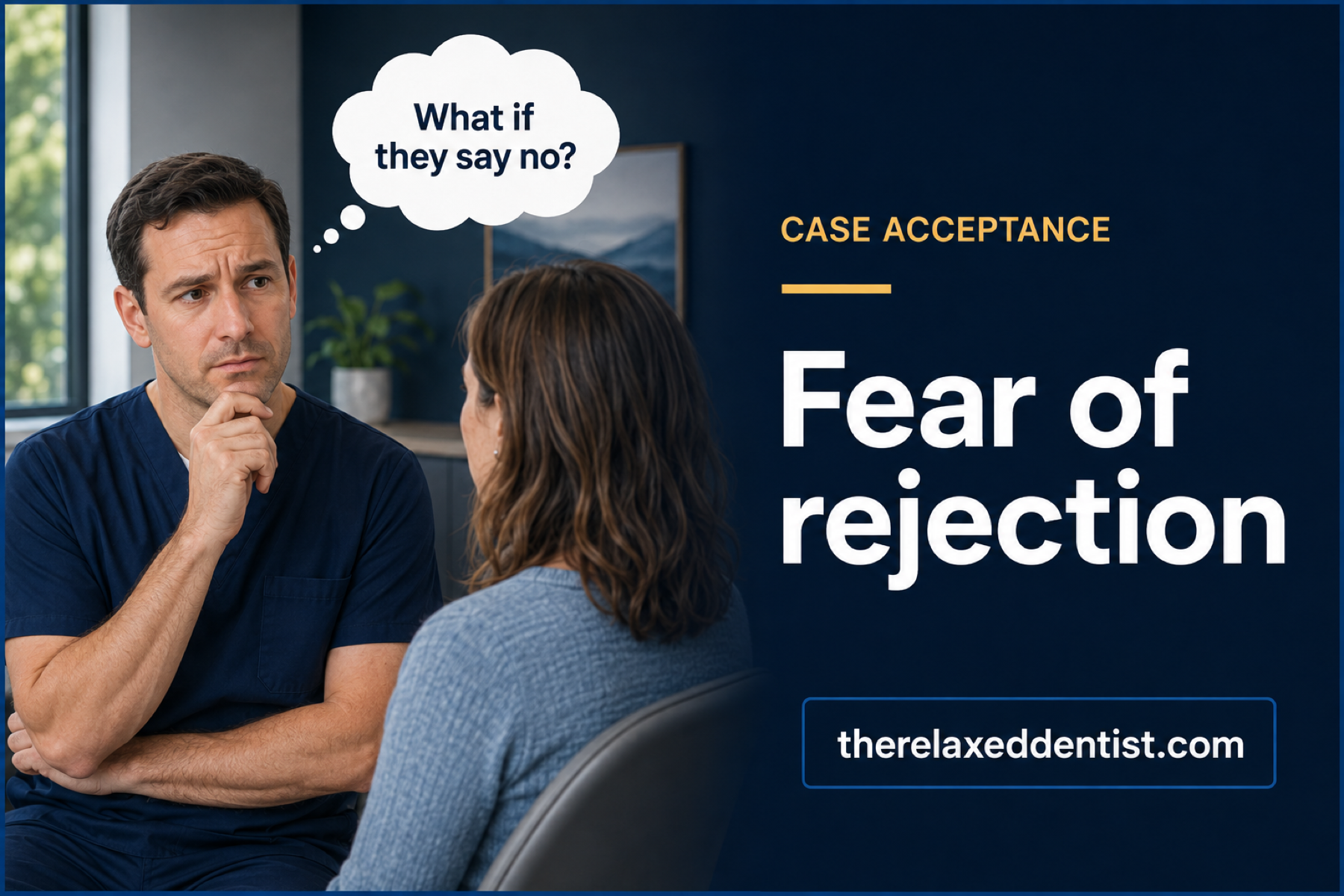
The more I talk with other dentists the more I realise that there’s an underlying fear in the profession. Many, perhaps most, dentists have a fear of rejection.
This fear shows itself in the way dentists communicate with their patients.
For example, let’s say a patient comes in with a broken tooth. Assuming the patient wants to fix it, there are two options. Either a filling (cheap but not long-lasting) or an onlay/crown (expensive but more reliable).
I’ve watched dentists who are rejection-averse avoid the possibility of rejection in two ways.
The first way is to short-circuit the treatment discussion. They simply say “I’ll fix that!” and then do a filling. This is emotionally safe. There is zero risk of rejection. However, they’re doing the patient a disservice. The patient didn’t get the opportunity to choose the best treatment. Such dentists can usually rationalise to themselves why the patient wouldn’t have chosen an onlay/crown.
The second way is to offer the patient an onlay/crown using vague, ambiguous language: “Ideally you could perhaps consider looking at doing a crown on the tooth.” By expressing yourself in this fashion there’s no chance of rejection because the patient doesn’t have a clue what you’re actually saying. A dentist who does this can tell themself that they offered the best treatment but the patient said no. I once heard a dentist say the word “ideally” seven times in a 10-minute treatment consultation.
When I first graduated from dental school I had tremendous difficulty discussing expensive treatment with patients. My way out was to use the a combination of the first and second methods above.
Gradually I realised that this is not the way to go. It’s not fair on the patients. I changed my approach and forced myself by sheer willpower to clearly present the best option to my patients every single time, no exceptions.
The good news is that my discomfort and fear of rejection only lasted for the first 200 patients. After that it was all plain sailing.