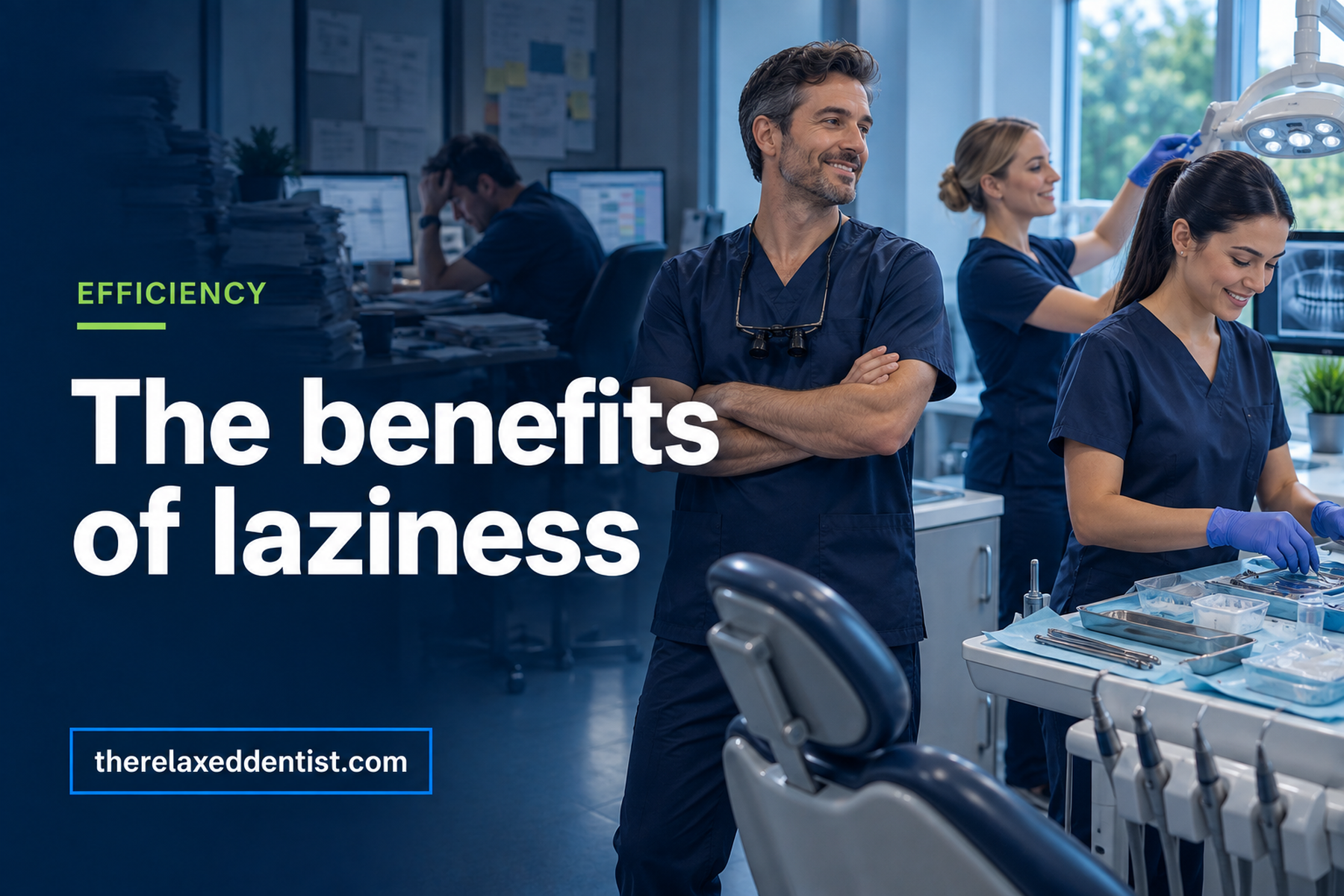
Some dentists arrive at the office early, work hard all day (including through their lunch break) and then stay back after work finishing paperwork. They even come in on their days off to do admin work.
They’re super conscientious but it’s a hard way to make a living. There is an alternative.
Other dentists get a lot more done with much less effort. They’re ultra productive while not working hard at all. I call these dentists “lazy dentists”. This article looks at the benefits of being lazy.
A lazy dentist wants to get the maximum done with the minimum personal effort. No unnecessary movement. No wasted energy. Minimal thought and decision making. How’s this achieved?
First, lazy dentists only do things that they’re mandated to do by law. They don’t fill in lab sheets, type on the computer or make bleaching trays. They employ sufficient staff and then train them well. Or, even better, they get the staff to train the new staff. If you’re a lazy dentist, all you do is diagnose and treat patients. Nothing else. A lazy dentist works with two DAs, i.e. 6-handed dentistry. Instruments and materials come without any delay.
Second, lazy dentists only have the most efficient, modern equipment and materials. If there’s a better handpiece, a sharper bur or a faster curing light a lazy dentist will buy it immediately. A lazy dentist never uses old, worn-out equipment.
Third, lazy dentists standardise everything. They don’t use five bonding agents, six composites and three different techniques for the same procedure. They decide the best way to do something and turn it into a routine. Familiarity equals speed.
Fourth, lazy dentists only solve problems once. When a problem gets solved, it’s documented in the practice manual so the staff never needs to ask the dentist about it again. Lazy dentists get called on very seldom to answer questions.
Fifth, lazy dentists avoid redoing work. They use magnification, isolation and reliable techniques. They take extra care with contacts points and occlusion because repairing yesterday’s dentistry is a frustrating way to spend today.
Sixth and finally, lazy dentists constantly improve workflows. There’s an old saying: “If you have a difficult task give it to a lazy person. They will find an easier way to do it.” A lazy dentist is always questing after simpler ways of doing things.
Your attention, judgement and energy are the most valuable resources in the practice. When your staff, systems and equipment carry the load, you can give patients more of what only you can provide while finishing the day with plenty left in the tank.
Hard work is not evidence of a well-run practice. Often, it is evidence of a poorly designed one. The goal is not to become busier, faster or more exhausted. It is to build a practice that works harder than you do. That is the virtue of laziness.
Would you like to be a lazy dentist?