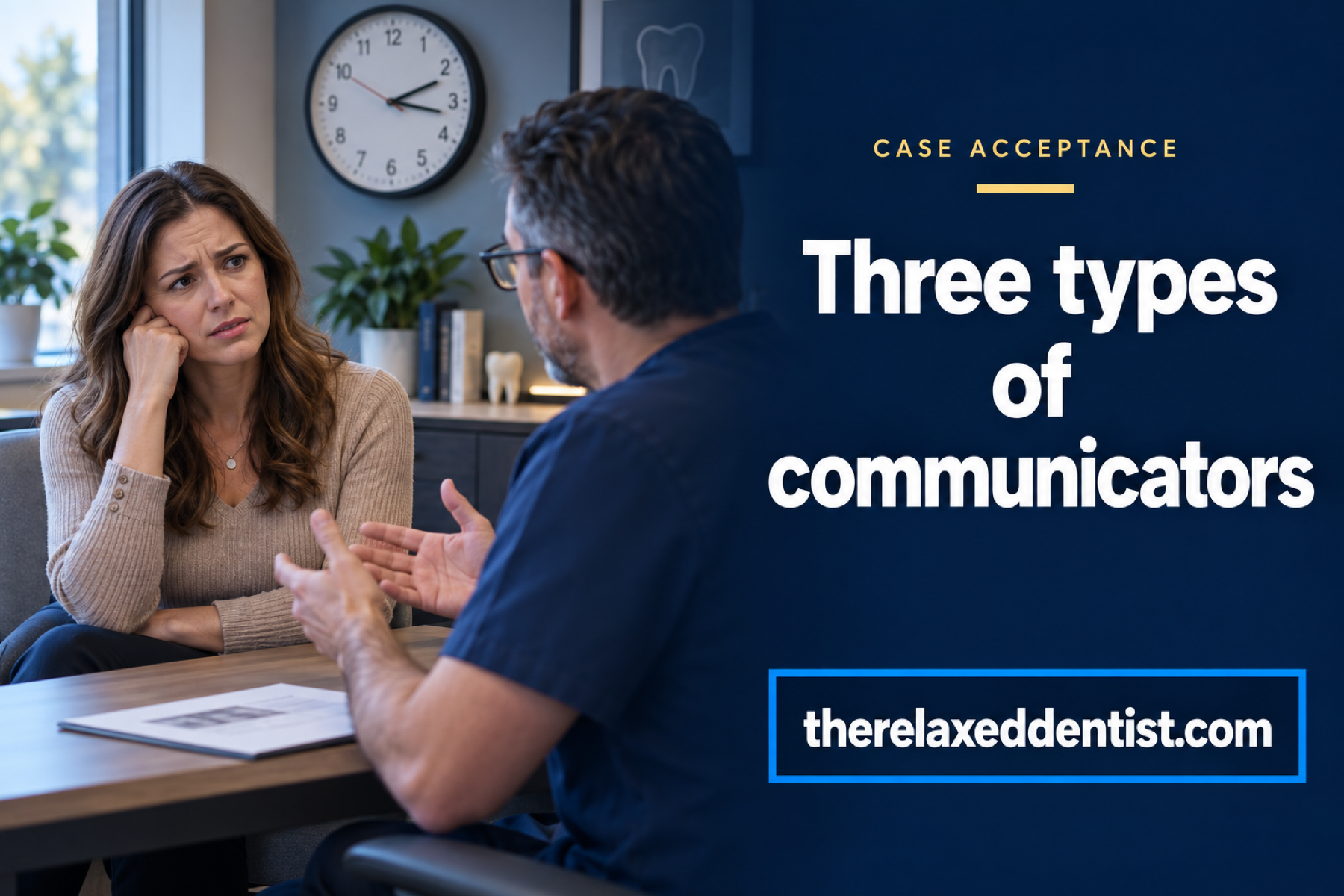
Over the years I’ve had the pleasure of sitting in the corner and watching dozens of dentists communicate with patients. The dentists fall into three categories:
Incoherent
They meander, use lots of jargon and talk about things that are interesting to themselves but not interesting to their patients. At the end of the consultation, the patient has no meaningful idea what was said and leaves promising to think it over.Coherent
They can communicate facts but seldom say anything memorable or persuasive. The patient has a slight idea about the treatment but does not clearly understand the benefits or the consequences of delay.Eloquent
They use words and body language to win over their patients. Patients are crystal clear about what their treatment options are, the pros and cons of each and the consequences of delay. The patient usually makes a decision straight away.
If I were to put percentages on the breakdown, they would be 60% of dentists are in category 1, 35% are in category 2 and 5% are in category 3. Interestingly, I’ve seen quite a few dentists who believe that they’re in category 3 but who are actually in category 1.
The worst example of that, that I’ve ever seen was a dentist who spent 45 minutes babbling to a patient about the technical details of treatment. It was a simple case. The patient wanted gaps between their front teeth closed — orthodontics or veneers. It doesn’t get easier than that. At the end, the patient was completely frustrated and confused.
“I’ll go home and think about it,” said the patient
“Yes, good idea,” replied the dentist.
The dentist thought that he’d done wonderfully well. He was so proud of his communication skills. His inability to read the patient’s obvious body language was quite astounding. I had to break the news to him that he could’ve explained the case much more clearly in 90 seconds. And, doing it in this way, he would have gotten a decision.
Where do you place yourself? Category 1, 2 or 3?