Hick’s Law
Some dentists tell me that, when they discuss treatment with patients, a common result is the patient says that they’ll “go home and think about it”.
A likely explanation is that the dentist is violating Hick’s Law.
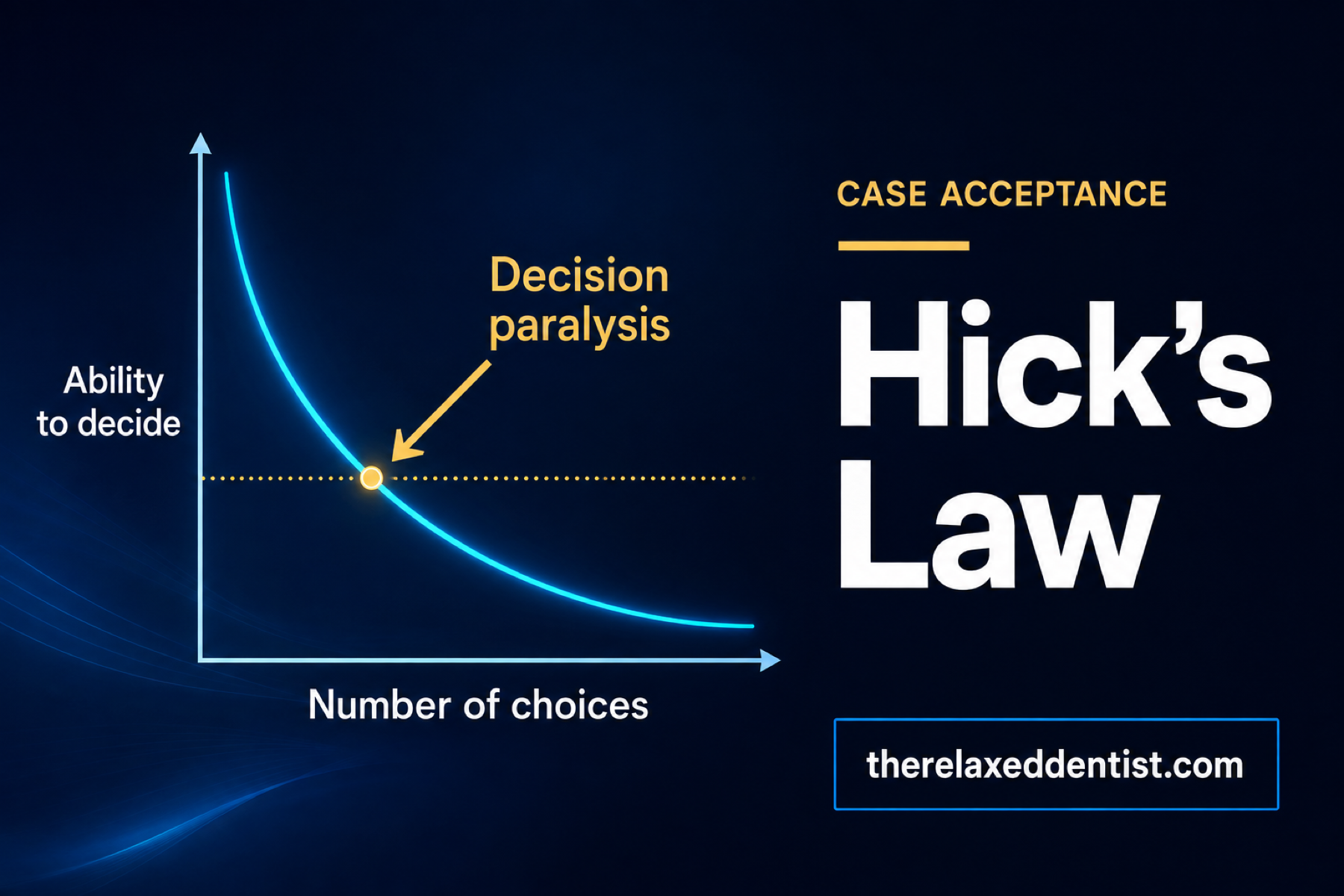
Hick’s Law states that the time it takes for a person to make a decision increases logarithmically as the number of options they have increases. In essence, the more options you give people the harder it is for them to make a decision.
At a certain point, usually 3 or at the most 4 options, patients reach a state called decision paralysis. They can’t decide between the various options so they become mentally frozen. They stop thinking. Once they stop thinking the only thing they can say is that they’d like to go home and think about it. It’s their way of getting out the door.
I had an example of that recently. A friend phoned me because they’d been to an endodontist and were hopelessly confused.
The endodontist had spent 45 minutes patiently and carefully laying out their options: Extraction followed by leaving the space, a bridge, a partial denture or an implant or saving the tooth with a root filling followed by a filling, an onlay or a crown.
The total was seven options. My friend had no clue which way to go.
I broke through the mental log jam with one single question: “Do you want to save the tooth or have it out?” My friend instantly replied: “Save.”
All I had done was reduce the complexity of the decision by taking the number of options from seven to two. That was what my friend needed in order to decide immediately.
If many of your patients are going home to think about it maybe you’re violating Hick’s Law.